


Take Your Bike on Transit in the Bay Area
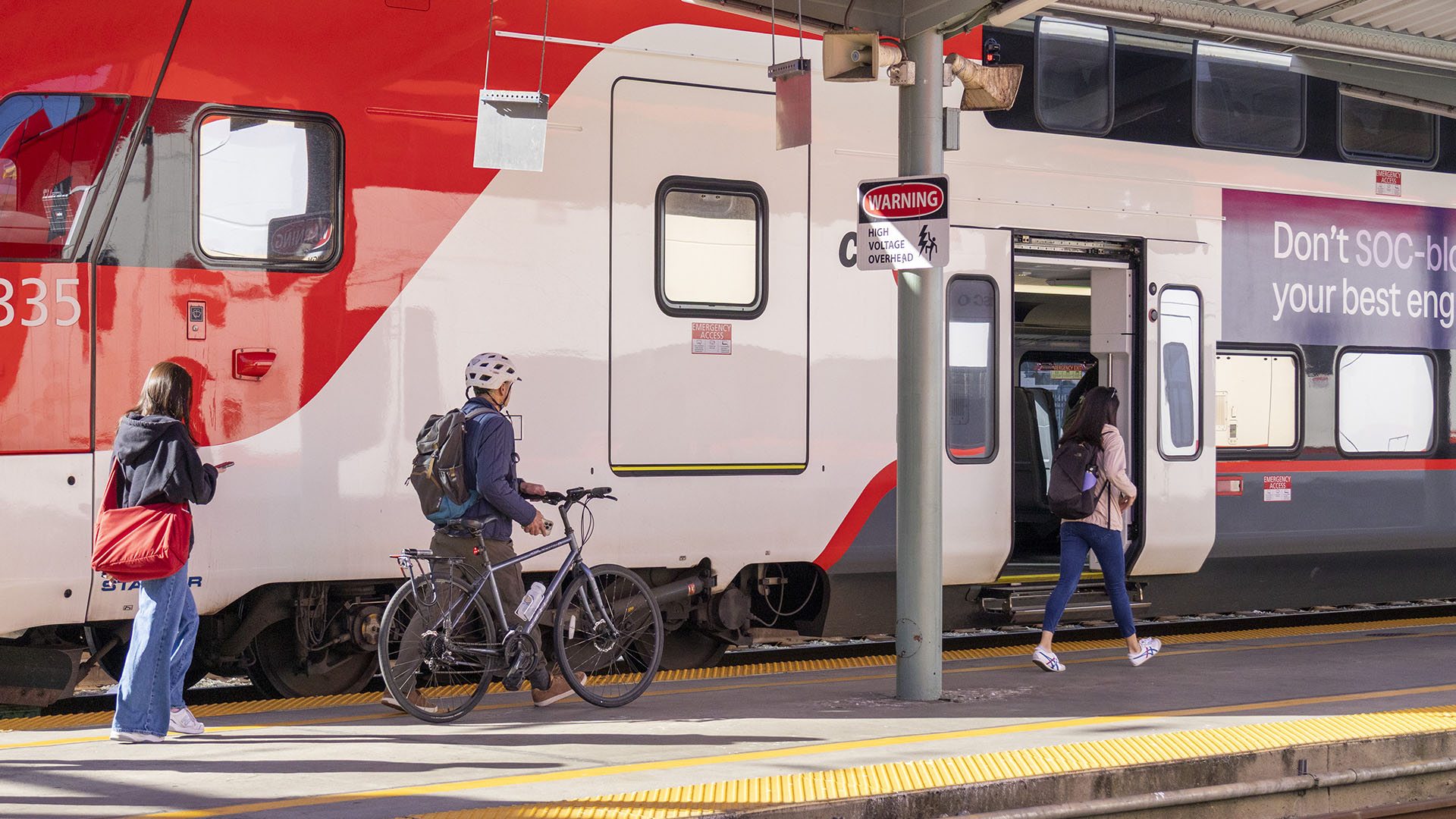
You can take your bike or your scooter on most transit vehicles in the Bay Area, helping you get farther than you might go on your own steam. (Those hills, right?)
The list below is a quick guide – with links for additional details by transit agency – that can help you re-envision your daily commute or plan a getaway with friends. And if you pay with Clipper, it’s even faster to board and get on to your next adventure.
Note that some transit agencies have restrictions on e-bikes/e-scooters on transit vehicles, due to their weight and battery safety concerns. If you want to ride transit with your e-bike or e-scooter, be sure to check the transit agency’s website for details first.
Public Transit Agencies
AC Transit
Regular AC Transit buses have bike racks at the front of the bus for two or three bikes. On Tempo, bikes can be rolled on board through the rear doors and into a bike rack inside the bus.
Collapsible/folding scooters are allowed on AC Transit vehicles, but owners must be in control and they cannot be left in the aisle or ADA seating areas. (Non-folding scooters are not allowed.)
Altamont Corridor Express (ACE)
Each bike car has 14 bike stalls, with two additional stalls on the lower level.
BART
Bikes are not allowed on the first car of a train, or on very crowded cars, but are otherwise allowed on BART.
Collapsible /folding motorized scooters (including electric-assist scooters) are allowed on BART, but they must remain folded and may not be ridden when inside BART stations and trains. (Non-folding scooters are not allowed.)
Caltrain
More than 20% of Caltrain riders bike to or from a station, and many bring their bikes onboard. Learn the Caltrain rules to ride with your bike.
Capitol Corridor (Amtrak)
Store your bike on the lower-level bike racks or in the designated bike cars (identified by a bike decal on the outside of the car) of the train. These cars are usually located either at the end of the train, opposite the locomotive, or the second car from the locomotive.
County Connection (CCTA)
Buses have a rack at the front of the bus that can hold two bikes.
Dumbarton Express
Buses have space for two bikes on the front of the bus.
FAST
All FAST buses have bike racks that can accommodate two bicycles, up to 50 pounds each (no e-bikes allowed).
Foldable, manual scooters are allowed on board. No battery and/or gas operated scooters are allowed.
Golden Gate Transit Ferry
Bicycles are welcome but note that you may need to carry your bike up or down a flight of stairs to embark/disembark. During peak periods, ferries may have a limit on the number of bikes that can be accommodated.
Electric scooters and e-bikes are allowed, but they must be powered off and the handle retracted for easy storage. No gas-powered vehicles allowed. See full policy for e-bikes and mobility devices on Golden Gate Ferry.
Golden Gate Transit Bus
There are two styles of Golden Gate Transit buses. One has a rack for three bikes at the front (e-bikes are allowed). The other style has underbelly bike racks that can hold two bikes (e-bikes are not allowed). You can call Golden Gate Transit customer service at 415-455-2000 to find out which type of bus will serve your stop.
LAVTA (Wheels)
Every bus has a rack that holds two bikes. If the rack is full, the driver may allow the bicycle to be brought inside the bus.
Marin Transit
All Marin Transit vehicles are equipped with bike racks that hold at least two bicycles.
Gas-powered bicycles are not allowed. Electric bicycles up to 55 pounds are allowed.
Muni (SFMTA)
Muni buses have bike racks that can hold two or three bicycles. Only folding bikes and folding scooters are allowed on the inside of trains and historic streetcars. Folding bicycles and folding scooters must be carried in the folded position. No bikes are allowed on cable cars.
Petaluma Transit
Front-mounted racks on buses can accommodate two or three bicycles.
Rio Vista Delta Breeze
All buses are equipped with racks that hold two regular bikes (no tandem, three-wheel or motorized bicycles).
SamTrans
SamTrans bus racks hold three bikes. Two additional bikes are allowed inside the bus, if space allows. E-bikes are only allowed on front racks. Bicycles up to 55 pounds are permitted. Bikes with gas-powered engines are not allowed on SamTrans.
San Francisco Bay Ferry
Every boat has bike racks for conventional bicycles and e-bikes. Space may be limited, so arrive early. Gas-powered bicycles and gas-powered scooters are not allowed.
Santa Rosa CityBus
Buses have a bike rack in front, and space may also be available inside the bus, if not needed by wheelchair users.
SMART
Bikes and scooters are allowed on board. Gas-powered bicycles/scooters are not allowed. Read the full SMART train bicycle policy.
SolTrans
Local buses have a rack on the front of the bus for up to two bicycles. Express buses have bicycle storage under the bus. Read the SolTrans Rider’s Guide for more details.
Sonoma County Transit
All buses have racks for two or three standard-sized bikes, with a few exceptions.
Tri Delta Transit
All buses have racks that hold up to two bikes. If space allows, the driver may let you bring your bike inside when the rack is full. Motorized vehicles are not allowed on Tri Delta Transit.
Union City Transit
Buses have bike racks on the front of the bus.
Vacaville City Coach
Buses have bike racks on the front of the bus.
Vine
All buses (except VineGo) have front bike racks for two to three bicycles.
VTA
All VTA buses (including the Dumbarton Express) have exterior bike racks for up to three bicycles. Rapid 522 buses (the long blue ones) can accommodate two additional bikes inside the rear of the bus. The Highway 17 Express can hold up to three bicycles; drivers may allow two additional bikes inside the bus, when space permits.
All light rail trains can accommodate up to six bikes in the center of the train car where it articulates (bends).
WestCAT
All WestCAT local fixed route, express and Lynx buses are equipped with bike racks that will hold up to two bicycles.
Folding bikes/scooters are allowed, and must be folded, not blocking the aisle. Non-folding scooters are not allowed on WestCAT.
Privately Operated Transit
Angel Island/Tiburon Ferry
The number of bicycles allowed on board is limited only by the space available. The fee is $1.00 per bike per round trip.
Emery Go-Round
There are two bike racks on the front of the bus.
Mission Bay TMA
Bikes can be loaded onto the rack at the front of the bus. E-scooters can be brought on board; they must be folded and stored at the back of the bus.
MVgo
All vehicles are equipped with bike racks.
Presidio GO Shuttle
All shuttles have racks for up to two bicycles.
South City Shuttle
Look for the bike rack on the front of the bus.
Treasure Island Ferry
These small ferry boats can accommodate up to six bikes. If you’re buying tickets online, be sure to include a (free) ticket for your bicycle in your order.
More Resources
Learn about secure bicycle parking and using your bike on certain bridges and tunnels by visiting 511.org.
Submit your comment
In order to receive a reply to your comment, please provide an email address.